

when do we stop being performative?
to the girl with the stacked rings and a skirt over her jeans

she's in your instagram stories, your tiktok feed, maybe even your ap psych class. thrifted band tee (definitely oversized), jorts, rings covering every finger like armor, hair that looks effortlessly messy but probably took twenty minutes to scrunch just right. those two strands in the front are definitely telling you something. she's reading joan didion in a coffee shop, photographing her matcha oat milk latte next to her copy of the bell jar, posting quotes about capitalism and consumerism while wearing vintage levi's that cost more than most people's rent.
she's not performing maliciously. she genuinely believes in everything she's curating. the thrift store finds, the stack of silver and beaded rings, the disheveled hair. it all feels real to her. somewhere between the impulse and the post, something gets lost in translation.
performance isn't inherently bad. maybe it's about performing toward becoming who we want to be rather than just for an audience.
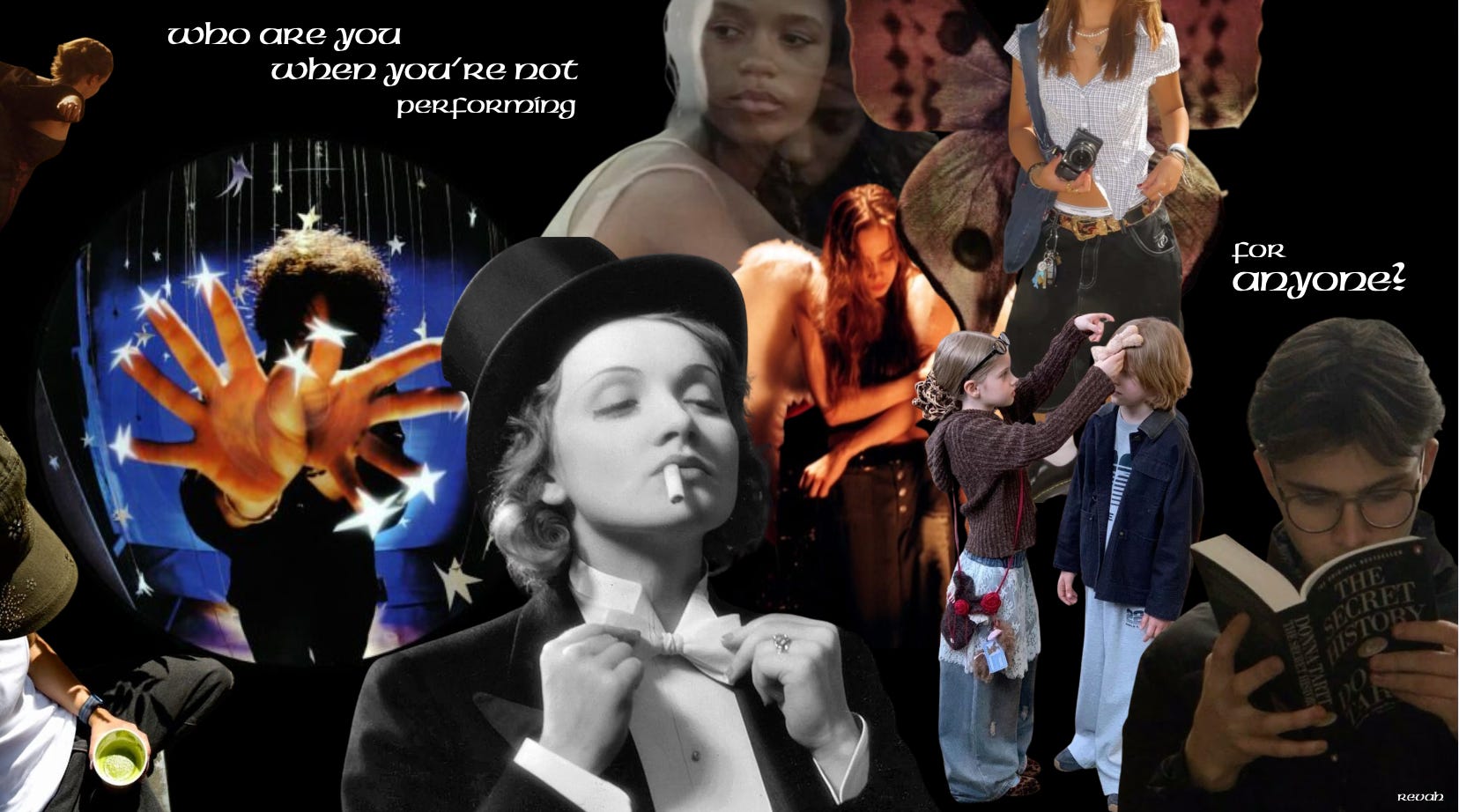
there’s a difference in self-expression and performatism.
sociologist erving goffman wrote about this in "the presentation of self in everyday life" back in 1956, long before social media existed. he argued that we're all constantly performing different versions of ourselves depending on our audience. but goffman couldn't have predicted how exhausting it would become when the stage never closes, when every moment of your day could become content. dr. sherry turkle, who studies digital culture at mit, talks about how social media creates what she calls "tethered selves"—versions of ourselves that exist primarily in relation to our online presence. we're not just performing for others anymore; we're performing for the algorithm, for the aesthetic, for some imaginary audience that includes everyone and no one.
the girl with the rings isn't just choosing accessories. she's choosing an identity that signals: i'm not like other girls, i read books, i care about the environment, i understand that mainstream fashion is a capitalist trap! each ring is a rebellion, a tiny threat to conventional beauty standards, except when everyone's rebelling in the same way, using the same visual language, shopping at the same stores…what exactly are we rebelling against?
walter benjamin warned us about this in his essay "the work of art in the age of mechanical reproduction." he wrote about how capitalism turns everything, even rebellion, into something that can be packaged and sold. the aesthetic of resistance becomes another product to consume. and god, we consume it beautifully! we've turned thrifting into an art form, sustainability into a brand, even our mental health struggles into content. the "messy girl aesthetic" isn't just about looking effortless. it's about performing effortlessness so well that it looks authentic.
i buy thrifted books not just because i want to read them, but because they photograph better than paperbacks and i saw some pretty girl online recommend them to me. i choose the drink that would look the best in my photos whether it tastes good or not. i angle my laptop screen just right before taking that candid study photo. we've become so good at performing authenticity that we've forgotten what it feels like to just exist without an audience. what it feels like to take a picture, not for the use of another photo dump weeks later.
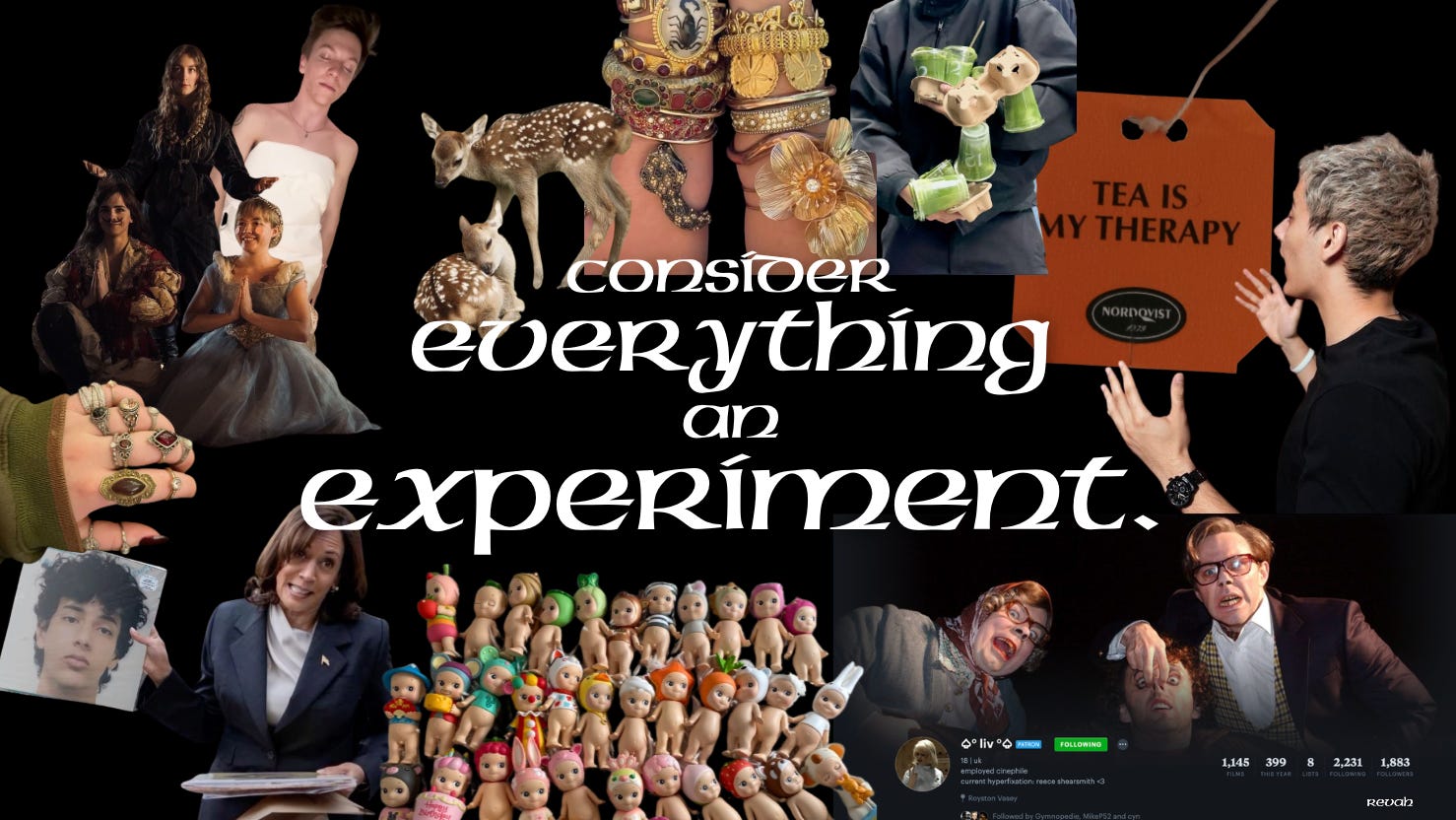
research from the american psychological association shows that young people spend an average of 7-9 hours a day engaging with media, much of it social. that's 7-9 hours of curating, performing, choosing which version of ourselves to present. no wonder we're exhausted.
when your entire identity becomes about not being mainstream, you end up creating a new kind of mainstream. the thrift store aesthetic becomes as rigid and demanding as any other beauty standard.
we know we're performing. we joke about it, make meta-commentary about our own performativeness, create ironic distance from our own behavior. but knowing doesn't make it stop. if anything, it makes it worse, because now we're performing awareness of our own performance.
i think about my mother who still dresses up to go to the grocery store because "you never know who you might see." she understood something we've forgotten: that caring about how you present yourself isn't inherently shallow. it can be an act of respect. for yourself, for others, for the world you move through.
maybe choosing to present yourself as someone who reads, who cares about the environment, who finds beauty in vintage things, is a way of becoming that person. maybe performance can be a kind of practice.
it only works if you remember that the performance is supposed to serve you, not the other way around. the moment your rings become a burden, when your thrifted clothes feel like a costume you can't take off, when your carefully curated feed starts to feel more real than your actual life—that's when the performance has eaten the person.
the girl with the rings will probably keep stacking them. she'll keep thrifting, keep photographing her coffee, keep trying to figure out who she is through the clothes she wears and the books she reads and the aesthetic she creates. and maybe that's okay. maybe that's just what it looks like to grow up in public, to become yourself when everyone's watching.
the trick is remembering that underneath all those rings, there are hands. hands that can touch, create, hold, comfort. hands that exist whether or not anyone's looking.
sources:
goffman, erving. "the presentation of self in everyday life." university of edinburgh social sciences research centre, 1956.
turkle, sherry. "alone together: why we expect more from technology and less from each other." basic books, 2011.
benjamin, walter. "the work of art in the age of mechanical reproduction." 1935.
american psychological association. "stress in america: generation z." harris poll, 2018.
taylor, charles. "the ethics of authenticity." harvard university press, 1991.'